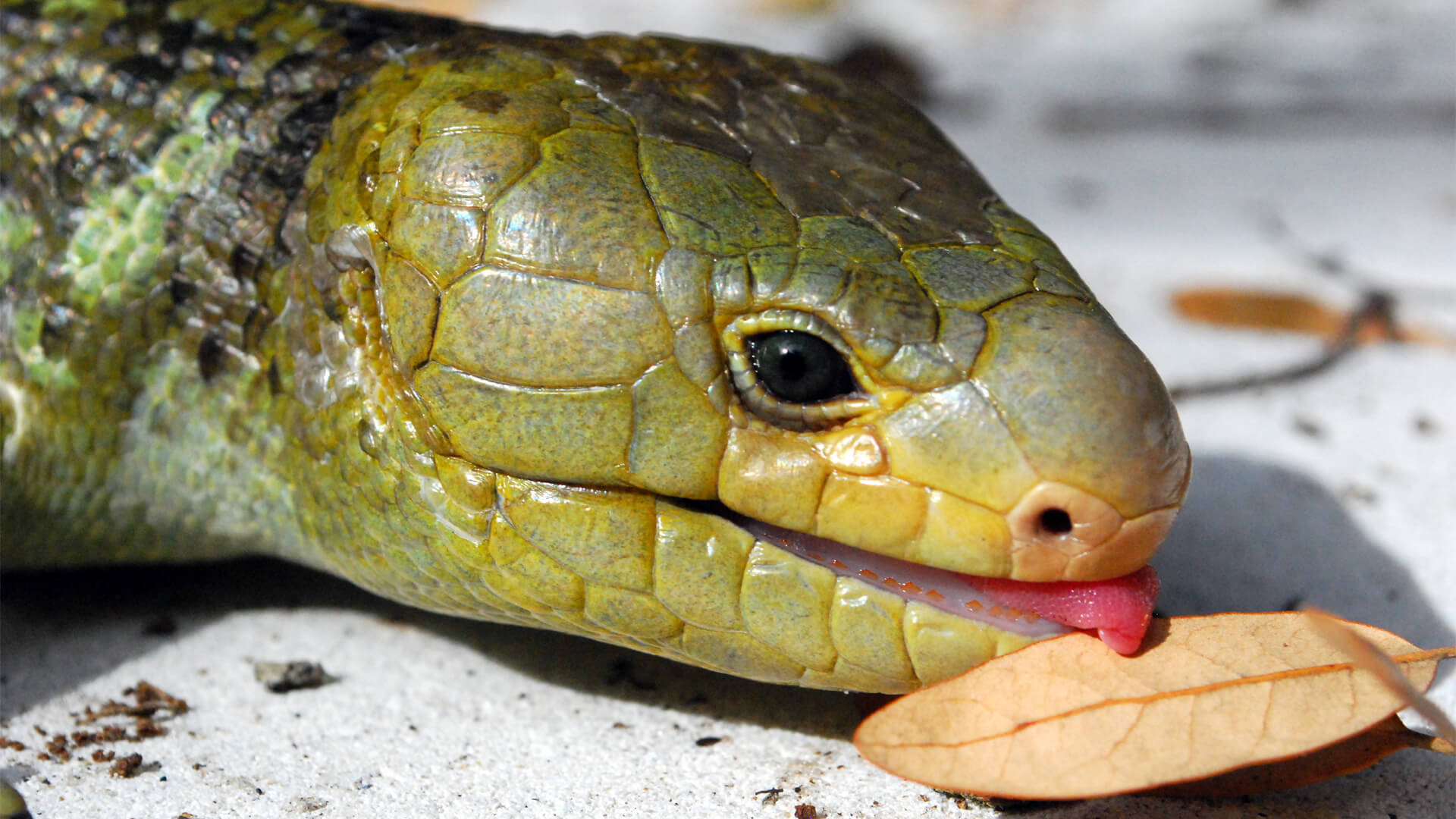

Being the largest skink in the world, these broad-headed and cylindrical lizards are tree dwellers. Their green scales, long claws and muscular tail aid in climbing in the canopies of the rainforests of the Solomon Islands.
Prehensile-tailed skinks are built for climbing and reaching their favorite food of leaves. They are crepuscular, which means that they are most active during the early morning and late evening hours. These are one of the few social lizards that have family groups and will defend their babies and territory against members of another group. The mothers care for their young for six months. After this time, the young may move on to create their own family group, or stay with their parents for a few more years.

The Prehensile-tailed skink, or monkey skink, actually uses its tail like a fifth leg. They are almost completely arboreal and rely on that tail as a safety net against falls. Their unique scale coloring allows them to stay camouflaged in the trees. That camouflage, along with their very slow speed when foraging, allows them to be almost invisible to predators.
Hilaire
Prehensile-tailed skinks are ovoviviparous, meaning the female hatches an egg inside her body and are later born.

Solomon Islands in the South Pacific

Canopies of tropical rainforests

81 cm (32 inches)

Leaves, flowers and fruit

Birds of prey, snakes, rats and humans

Strong jaws, loud hiss, excellent eyesight and sense of smell

Ovoviviparous; one or two live offspring

Not Listed

Can live 15 years in human care