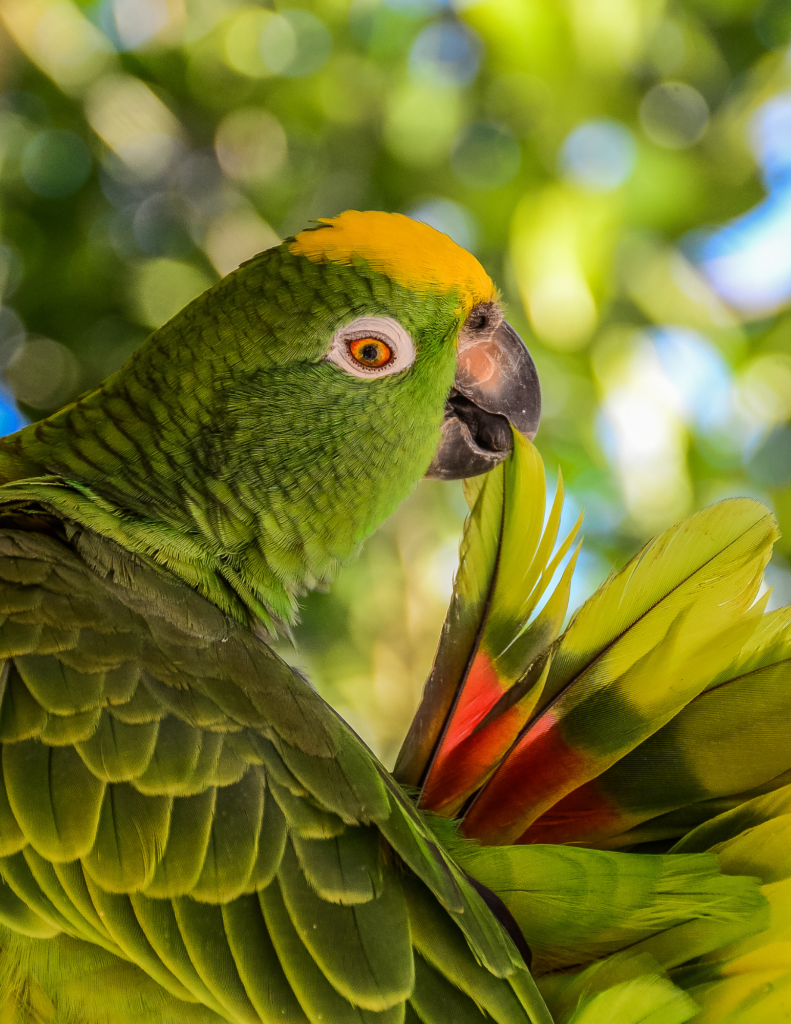
Height: 13-14 in Wingspan: 8-8.5 in Weight: 0.8-1.3 lbs
native habitat
Tropical forests, woodlands, scrublands of Central Mexico to Central South America, some Caribbean islands
diet
Fruits, seeds, nuts
Reproduction
Females lay a clutch of 2-4 eggs each breeding season
life expectancy
56 years on average
predators
Boa constrictors, humans
natural defenses
Camouflage, sharp bill, flight
About the Species
These blunt-tailed parrots are mainly green, which aids in camouflage. At the Zoo, our yellow-crowned Amazon is an ambassador animal, helping connect guests with wildlife through educational experiences.
Yellow-crowned amazon parrots are one of over 30 species in the genus Amazona.
These parrots are common throughout their range, which includes much of Mexico, all of Central America, and most of the Amazon River Basin. They are highly social, often found in massive groups. These flocks maintain their social bonds through a variety of vocalizations. During the breeding season, these monogamous parrots build nests in cavities high in the treetops of tropical forests. Yellow-crowned Amazon chicks are altricial upon initially hatching, which means that they rely heavily on parental care and are incapable of fending for themselves.
These birds eat foliage, seeds, and fresh fruit. They are messy eaters, tossing and dropping a significant portion of their food on the ground. Foraging herbivores such as tortoises rely on these sloppy feeding habits for much of their own diets, and you can see this natural interaction in our mixed-species habitat here at the Zoo, as our yellow-crowned Amazon lives with several tortoise species.
When fruits and seeds pass through their digestive systems, protective casings are softened or dissolved; when the seeds are finally excreted, they can drop to the forest floor and germinate. All-in-all, parrots play an important role in their ecosystems, proving indispensable to the food webs in which they participate. They are sedentary during the day, nestling themselves in small groups amongst the foliage of thick tropical forests. They sleep in large groups to reduce the risk of predation.
SCIENTIFIC NAME
Amazona ochrocephala
Fun Fact
Parrots play the important role of seed dispersers in their ecosystems.