42 Eastern indigo snakes released across Florida and Alabama in continued species recovery effort

SANFORD, Fla. (June 4, 2026) – The Central Florida Zoo & Botanical Gardens’ Orianne Center for Indigo Conservation (OCIC) continues its long-term effort to restore the Eastern indigo snake to its natural habitat with two recent releases in partnership with leading conservation organizations across the region.
In late April and early May 2026, conservation teams released a total of 42 juvenile Eastern indigo snakes—21 at The Nature Conservancy’s Apalachicola Bluffs and Ravines Preserve (ABRP) in the Florida Panhandle on April 28, and another 21 in Conecuh National Forest in Alabama on May 8.
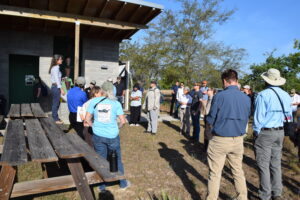
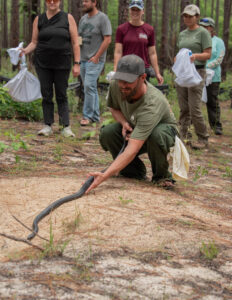
This year’s Apalachicola release also represents a significant milestone: the 10th annual release at ABRP since the program began in 2017, underscoring nearly a decade of sustained restoration and partnership in one of Florida’s most carefully managed longleaf pine ecosystems.
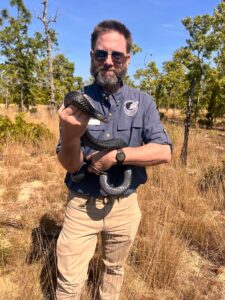
“Every release adds another layer of critical data that helps us understand how these snakes are adapting, surviving, and reproducing in the wild,” said Dr. James Bogan, Director for the Central Florida Zoo’s Orianne Center for Indigo Conservation. “Over time, that information is what transforms a reintroduction effort into a self-sustaining population recovery.”
The Eastern indigo snake—North America’s longest native snake and a non-venomous apex predator—plays an important ecological role in maintaining balance across longleaf pine and sandhill habitats. The 2026 releases continue a multi-agency effort led by The Nature Conservancy, OCIC and a broad coalition of state, federal and nonprofit partners.
Snakes released into Apalachicola Bluffs and Ravines Preserve and Conecuh National Forest are bred and hatched at OCIC and raised in partnership with additional wildlife facilities before being reintroduced into restored habitat. The hatchlings are carefully monitored and cared for at the OCIC for about a year before typically being transferred to a partner agency for another year of growth and preparation prior to release.
Eastern indigo snakes were historically found in southern Georgia, Alabama, eastern Mississippi and throughout Florida. Largely eliminated from northern Florida due to habitat loss and fragmentation, Eastern indigo snakes were last observed at ABRP in 1982, until the species recovery effort began in 2017.
Field monitoring continues to demonstrate the effectiveness of the program. The 2024-2025 winter-spring survey identified a female snake originally released in 2019, along with 19 other snakes released between 2020 and 2024. Researchers have also observed a six-foot-long male and two wild-born hatchlings, signaling continued progress toward establishing self-sustaining populations in their native range.
“With each monitoring season, we’re seeing stronger evidence that these snakes are not just surviving, but integrating into the ecosystem,” said OCIC biologist Michelle Hoffman. “That progress is incredibly encouraging and speaks to the resilience of the species when given the right habitat and support.”
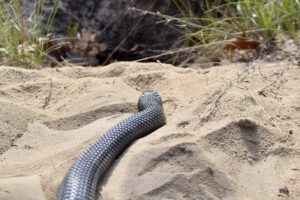
The Eastern indigo snake (Drymarchon couperi) is the longest snake native to North America and an iconic and essential component of the now rare southern longleaf pine ecosystem. The species serves a critical function to balance the wildlife community by consuming a variety of small animals including both venomous and non-venomous snakes. Reaching lengths over eight feet long, eastern indigo snakes living in the northern part of their range often rely on gopher tortoise burrows for shelter during cold weather.
For more information about the OCIC, visit https://www.centralfloridazoo.org/orianne-center-for-indigo-conservation-ocic/.